
How do you know when a piece of clothing hanging in your closet has served its purpose? Not when it wears out, most people stop wearing things long before that. The difficulty is not physical. It is psychological. Research in behavioural economics identifies two mechanisms that make this decision harder than it should be: loss aversion, the tendency to weight potential losses more heavily than equivalent gains, and the endowment effect, which causes people to overvalue objects simply because they own them (Thaler, 1980; Kahneman & Tversky, Prospect Theory). Both apply directly to wardrobes.
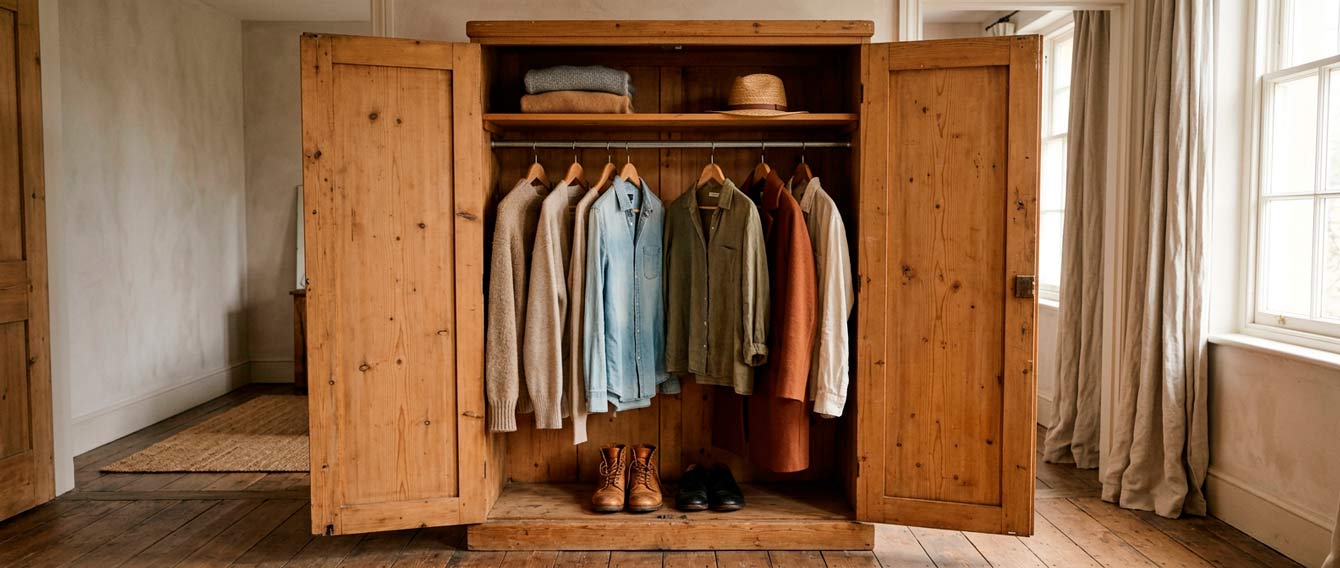
What the One-Year Threshold Actually Measures
The one-year rule is not about fashion cycles or trends. It is a proxy for actual behaviour. A full year covers all four seasons, major life occasions, professional commitments, travel, and changes in weather. If a garment has passed through all of those contexts and was never selected, the behavioural evidence is sufficient: it is not being worn.
This matters because people tend to evaluate clothing on potential rather than pattern. “I could wear this to a wedding” or “I’ll use this when the weather changes” are future-tense assessments that rarely become present-tense choices. The one-year test eliminates speculation and substitutes observation.
Context: Global clothing production doubled between 2000 and 2015, while the duration of garment use fell by 36%. The average garment is now worn 7 to 10 times before disposal. (UNEP, 2025)
Against that backdrop, a full year is a conservative threshold. For most wardrobes, twelve months is longer than the active life of many items already.
Applying the Test, Item by Item
The framework reduces to two questions. Applied in sequence, they handle most wardrobe decisions without requiring prolonged deliberation:
| # | Question | Decision |
|---|---|---|
| 1 | When did you last wear it? | Over 12 months ago → move to the next question. Under 12 months → keep. |
| 2 | Would you wear it the next chance you have? | Yes, genuinely → keep. Uncertain or ‘maybe someday’ → pass it on. |
A few clarifications on how to apply this consistently:
- Count actual occasions, not hypothetical ones. “I would have worn it” is not evidence of use.
- Seasonal items get a full cycle. A coat assessed in spring should have been worn at least once during the preceding winter.
- Gifts and rarely-worn formal wear often cluster around question two. If the honest answer is “probably not”, that is an answer.
- Size changes are a separate category. If an item no longer fits, it has already left active circulation regardless of the one-year window.
When Sentimental Value Complicates the Decision
Memory attachment is the most common reason the two-question framework stalls. Behavioural research describes the underlying mechanism clearly: when an object is associated with a significant memory or personal history, owners tend to assign it a value that bears little relationship to its actual use (Knutson et al., 2007; University of Michigan, 2023). The object becomes a vessel for the experience rather than a functional item in the wardrobe.
The decision does not require choosing between the memory and the garment. Photographs, keeping one representative item from a significant period, or passing something to a person who will actually use it are all ways of honouring the association without letting it stall a practical decision. The goal is not to eliminate attachment. It is to prevent it from accumulating across an entire wardrobe.
“People overvalue objects they own not because of what those objects do, but because of what they represent. Recognising that is the first step to a rational decision.”
— Thaler & Sunstein, Nudge (2008)
Where Removed Clothes Can Actually Go
The destination of removed clothing matters. Globally, 92 million tonnes of textile waste is produced each year, with 57% ending up in landfill and around 25% incinerated (UNEP, March 2025). Only 20% of discarded textiles are collected for reuse or recycling globally, and less than 1% of old garments are recycled into new ones. Extending the life of clothing by passing it to someone who will use it is the most direct intervention available.
Options, in approximate order of environmental preference:
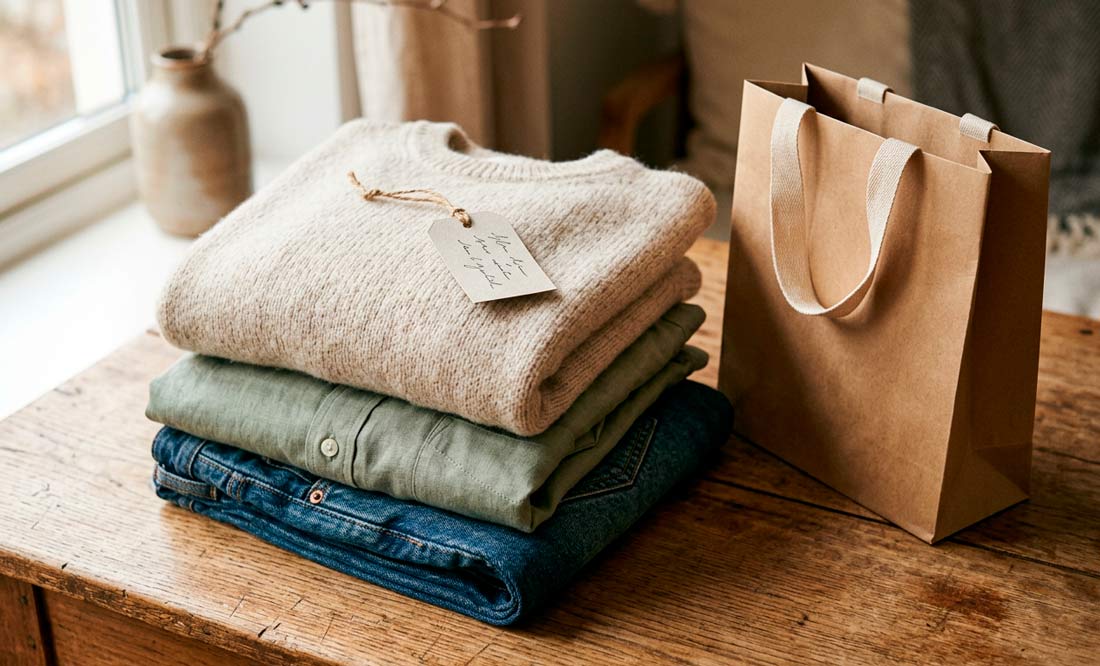
- Resale: Online platforms (domestic and international) for items in good condition. Condition and photography affect outcomes significantly.
- Donation to operational charities: Organisations such as the Salvation Army, Value Village, and Oxfam accept wearable items and redistribute them locally. Most publish eligibility guidelines online.
- Textile recycling: For worn, stained, or damaged items that cannot be resold or donated. Many municipalities operate textile collection points. In Canada, the Textile Recycling Association and local municipal waste programs maintain drop-off locations.
- Brand take-back programs: Several apparel brands now operate in-store collection or mail-in programs for their own garments. Availability varies by region.
WRAP (2024): Extending the active life of a garment by just nine months reduces its carbon, water, and waste footprint by 20–30%.
EPA (2018): The textile recycling rate in the US is approximately 14.7%. The vast majority of discarded clothing still reaches landfill.
The Same Principle Applied to Other Belongings
The one-year test is not specific to clothing. The same logic, usage patterns over a fixed interval as a decision proxy, applies to any category of object or information accumulation.
Books: If a book has been on the shelf unread for a year and is unlikely to be read in the next, the same two questions apply. A book passed to a library, a secondhand bookshop, or a community shelf generates use where it would otherwise occupy space.
Tools and household equipment: Items purchased for a specific task and unused since are candidates for donation or resale. Community tool libraries in many Canadian cities accept working tools.
Digital files and email: The same threshold translates directly to digital contexts. Emails unread or unactioned for twelve months are unlikely to become relevant. Files not accessed in a year can be archived or deleted. The decision logic is identical, the only difference is that digital clutter carries no storage cost visible enough to motivate action.
Sources and References
UNEP – Unsustainable Fashion and Textiles (March 2025) · unep.org
WRAP – Valuing Our Clothes: The Cost of UK Fashion (2024 update) · wrap.ngo
EPA – Textiles: Material-Specific Data (2018, current reference page) · epa.gov/facts-and-figures-about-materials-waste-and-recycling
Thaler, R. H. (1980). Toward a positive theory of consumer choice. Journal of Economic Behavior & Organization.
Kahneman, D. & Tversky, A. (1979). Prospect Theory: An Analysis of Decision under Risk. Econometrica.
Liu, T. et al. (2023). Neural correlates of overvaluation and the effort to save possessions. Frontiers in Psychology. University of Michigan.
Thaler, R. H. & Sunstein, C. R. (2008). Nudge: Improving Decisions About Health, Wealth, and Happiness. Yale University Press.