
The Secondhand Economy in 2026: Data, Trends & What Circulates
The world is getting worse at reusing what it already has. In 2025, only 6.9% of all materials in the global economy came from recycled sources, down from 9.1% in 2018. More is being made, less is being returned. The data that follows explains where goods go, and what it costs when they don’t come back.

The Circularity Gap: Why Reuse Has Become Urgent
6.9%
Global circularity rate in 2025 – down from 9.1% in 2018
Despite three decades of recycling policy and growing public awareness, the world is becoming less circular, not more. Material consumption is growing faster than recycling infrastructure can handle. The Circularity Gap Report 2025, published by Circle Economy in collaboration with Deloitte Global, found that only 6.9% of the 106 billion tonnes of materials used annually come from recycled sources, down 2.2 percentage points since 2015.
The report’s core finding is unambiguous: even a theoretically perfect global recycling system would not resolve the material crisis. The necessary shift is toward reducing consumption and extending the useful life of goods through reuse and redistribution.
| Indicator | Value | Source |
|---|---|---|
| Global material use per year | 100 billion metric tons | WRI, 2025 |
| Share from non-renewable sources | 75% | WRI, 2025 |
| Global circularity rate (2025) | 6.9% | Circle Economy, 2025 |
| Projected landfill volume by 2050 | 1.09 billion tonnes | UNEP / World Bank, 2026 |
| OECD countries: municipal waste recycled | 35% | WRI / OECD, 2025 |
Canada’s Secondhand Market in Numbers
$3.1B
Used Goods Stores industry revenue in Canada (2026)
2,195
active used goods businesses across Canada (2025)
Canada’s used goods sector has grown steadily through both economic downturns and recoveries, a structural characteristic of the resale industry globally. According to IBISWorld’s October 2025 report, the Used Goods Stores industry in Canada generated an estimated $3.1 billion in revenue in 2026, with 2,195 active businesses operating across all regions. Revenue grew 2.1% in 2025, driven by the combination of thrifting culture, value-seeking behaviour, and the expansion of omnichannel retail.
The industry is countercyclical by nature: demand rises when household budgets tighten, and holds during recoveries as sustainability-motivated consumers and vintage seekers maintain engagement. This makes secondhand retail unusually resilient compared to conventional retail segments.
| Indicator | Value | Source / Date |
|---|---|---|
| Used Goods Stores industry size (Canada) | $3.1 billion | IBISWorld, Oct 2025 |
| Active businesses in category | 2,195 | IBISWorld, Oct 2025 |
| Industry revenue growth (2025) | +2.1% | IBISWorld, Oct 2025 |
| CAGR: used goods stores 2020–2025 | 1.5% | IBISWorld, Oct 2025 |
| Canada fashion resale market (2023) | $4.5 billion | Industry data, 2023 |
| Canada fashion resale YoY growth | +15% | Industry data, 2023 |
| Largest operators | Savers Value Village, Salvation Army | IBISWorld, Oct 2025 |
| North America: resale as % of total retail (2030 target) | 8% | OfferUp 2025 Recommerce Report |
Market dynamic: Canadian used goods retailers benefit from both downturns (trade-down behaviour) and recoveries (vintage/curation demand), keeping revenue swings contained relative to conventional retail.
Competitive note: For-profit entrants are gaining share by paying more for desirable merchandise and running tighter operations, alongside competition from peer-to-peer platforms like Facebook Marketplace and Kijiji.
What Goods Circulate Most Effectively
“Recommerce is more than a trend. It’s a growing economic engine that provides consumers with affordable, high-quality goods and gives entrepreneurs, small businesses, and resellers access to trusted, thriving marketplaces.”
— U.S. Representative Sydney Kamlager-Dove, at the formation of the Recommerce Caucus, 2025
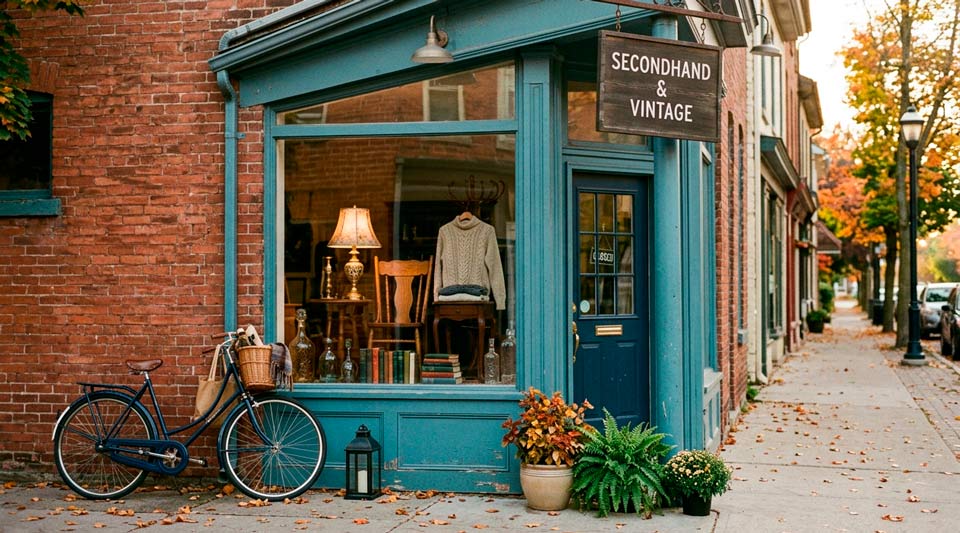
A common assumption is that secondhand trade is primarily about clothing. The data does not support this. According to OfferUp’s 2025 Recommerce Report, 75% of all recommerce activity falls outside fashion, spanning electronics, furniture, sporting goods, automotive parts, and collectibles. One of the quieter but faster-growing segments is office goods: desks, chairs, IT equipment, and storage systems that leave circulation not because they stop working, but because companies relocate, downsize, or refresh their spaces. Each category has distinct characteristics that determine how easily it moves.
| Category | Typical Discount vs. New | Key Data Points |
|---|---|---|
| Electronics | 40–60% below retail | 300M+ used smartphones shipped globally per year; 15% of global secondhand market |
| Clothing & apparel | 60–80% below retail | 25% of recommerce activity; fashion resale growing 2× faster than new apparel |
| Furniture & home goods | 50–80% below retail | 17% of furniture market is secondhand; IKEA launched resale marketplace Jan 2026 |
| Vehicles & auto parts | Varies significantly | Largest single resale category by value in North America |
| Books | 70–90% below retail | $20B global market; CAGR ~8% to 2028 |
| Luxury goods (watches, bags) | 30–50% below retail | Luxury resale at $41.6B in 2026; watches projected 35–40% of global watch market by 2030 |
| Sporting goods | 30–60% below retail | Winmark network (Play It Again Sports, etc.) recycled 2B+ items since 2010 |
| Office equipment & furniture | 40–60% below retail | 48% of Fortune 500 include secondhand in IT/furniture procurement (2025) |
January 2026: Ingka Group (largest IKEA retailer) launched a secondhand marketplace in Sweden for pre-owned IKEA products, with planned expansion to Spain, Norway, Portugal, and Poland.
Key finding: In 2025, 48% of Fortune 500 companies included secondhand or refurbished goods in approved vendor lists for IT equipment and office furniture. (DataIntelo, 2025)
Office assets occupy a specific position in the secondhand economy. Unlike consumer goods, they tend to be higher-value, lower-wear, and available in volume, a single office relocation can release hundreds of chairs, monitors, and filing cabinets at once. This bulk availability makes B2B redistribution more efficient than individual resale. According to industry data, refurbished commercial furniture and IT equipment typically sell at 40–60% below original cost while retaining most of their functional life. The environmental case is equally straightforward: keeping an office chair in use for an additional three to five years avoids the full carbon cost of manufacturing a replacement.
Environmental Gains of Reselling vs. Discarding
Lifecycle analysis across product categories consistently finds that extending a product’s useful life generates measurable reductions in carbon emissions, water use, and landfill volume. The gains are not marginal, in several categories, reuse outperforms recycling by an order of magnitude.
| Product | Environmental gain from reuse | Source |
|---|---|---|
| Clothing (any garment) | 70× lower environmental impact than new production | EU textile lifecycle analysis |
| Clothing (+9 months of use) | 20–30% reduction in carbon, water, and waste footprint | WRAP, 2024 |
| Smartphones (global resale) | Prevents 1 million tonnes of e-waste annually | Resale industry data, 2025 |
| eBay platform (2024) | Avoided 1.6M metric tons CO₂; kept 70,000 tons out of landfill | eBay 2024 Recommerce Report |
| US fashion resale (annual) | Reduces fashion waste by 2.5 billion pounds | Industry aggregate, 2025 |
| Extending item lifespan (any) | Reduces production impact by 30% per item | WRAP / lifecycle data |
“Even in the ideal world, we cannot solve the triple planetary crisis by mere recycling. The much-needed systemic change requires fundamental transformation, unlocking circular potential in existing stocks and stopping the disposal of perfectly reusable materials.”
— Circle Economy, Circularity Gap Report 2025
Workforce and Economic Scale
121–142 million
people work in circular economy activities globally
The circular economy is a significant employment sector. A joint study by the ILO, World Bank, and Circle Economy published in December 2025 found that between 121 and 142 million people worldwide work in circular economy activities, including repair, recycling, secondhand trade, and waste management, representing 5 to 5.8% of all global non-agricultural employment.

The primary employment segments within this economy include:
- Repair and refurbishment services electronics, appliances, vehicles)
- Secondhand retail, brick-and-mortar and digital-first platforms
- Reverse logistics and returns processing
- Material sorting, grading, and resale infrastructure
- Digital platform operations for peer-to-peer and B2B exchange
Key Developments in 2025–2026
| Date | Development | Significance |
|---|---|---|
| Jan 2026 | IKEA (Ingka Group) launches secondhand marketplace in Sweden | Major retailer formalising pre-owned sales within its own ecosystem |
| Nov 2025 | Goodwill launches store modernisation; opens 42 new retail locations | Physical secondhand retail expanding alongside digital competition |
| Aug 2025 | Winmark network passes 2 billion items recycled since 2010 | Scale proof point for franchise-based resale across North America |
| Dec 2025 | ILO/World Bank/Circle Economy publish circular jobs report | First comprehensive global estimate of circular economy employment |
| May 2025 | Circle Economy releases Circularity Gap Report 2025 | Circularity rate confirmed at 6.9%, down from 9.1% in 2018 |
| 2025 (ongoing) | US Congress forms bipartisan Recommerce Caucus | Policy recognition of recommerce as economic and environmental priority |
| 2026 (ongoing) | EU CSRD requires site-level waste auditing for large listed companies | Corporate circular reporting now mandatory in Europe |
Frequently Asked Questions
For most categories, yes. Lightly-used electronics sell for 40–60% below retail. Secondhand furniture commonly lists at 50–80% discounts. The economics favour sellers in high-demand categories and buyers across nearly all of them.
Fast fashion at low price points, perishables, highly personalised items, and anything requiring safety certification (car seats, certain electronics) typically resell poorly or carry liability concerns that limit demand.
Reuse means an item is used again in its original form – resold, donated, or redistributed without breakdown. Recycling means the item is broken into raw materials and reprocessed. Reuse is generally preferable in energy and emissions terms, as it skips the processing step entirely. Only 3.8% of all recycled material globally originates from everyday household items (Circle Economy, 2025).
Yes, and the scale is larger than most assume. In 2025, 48% of Fortune 500 companies included secondhand or refurbished goods in their approved procurement lists for IT equipment and office furniture. Office environments are well-suited to circular asset flows: goods are typically well-maintained, available in volume during relocations or decommissions, and hold enough residual value to make redistribution worthwhile. A single mid-size office move can release hundreds of reusable items simultaneously (chairs, desks, monitors, storage) at a fraction of replacement cost. B2B platforms and asset redistribution services handling this category operate actively across North America, including Canada.
IBISWorld’s data reflects formal used goods store revenue, not the full picture. Peer-to-peer platforms (Facebook Marketplace, Kijiji, Vinted) and brand-operated resale programs operate outside this category. The $3.1B figure represents only the brick-and-mortar and omnichannel store segment. Total Canadian secondhand activity is substantially larger.
Sources and References
Circle Economy/Deloitte Global – Circularity Gap Report 2025 (May 2025) · circularity-gap.world
World Resources Institute – 9 Key Findings on Global Progress Toward a Circular Economy (Sep 2025) · wri.org
IBISWorld – Used Goods Stores in Canada (October 2025) · ibisworld.com
ThredUp – 2025 Resale Report · thredup.com
OfferUp – 2025 Recommerce Report · offerup.com
WRAP – Clothing lifecycle and reuse data · wrap.ngo
ILO / World Bank / Circle Economy – Circular Economy Jobs Report (December 2025)
DataIntelo – Second-Hand Products Market Research Report 2034 (2025) · dataintelo.com
eBay – 2024 Recommerce Report · ebay.com
UNEP/World Bank – What a Waste 3.0 (March 2026) · unep.org
Trellis.net – In these sectors, second-life sales are growing beyond fashion (December 2025) · trellis.net
DISCLAIMER: This site is for informational purposes only. All statistics come from publicly available sources and were accurate as of early 2026. Numbers may differ between research firms depending on how they define the market.
This domain was previously operated by HYON Software Inc., a Canadian asset management company. We have no affiliation with that business or its former owners.